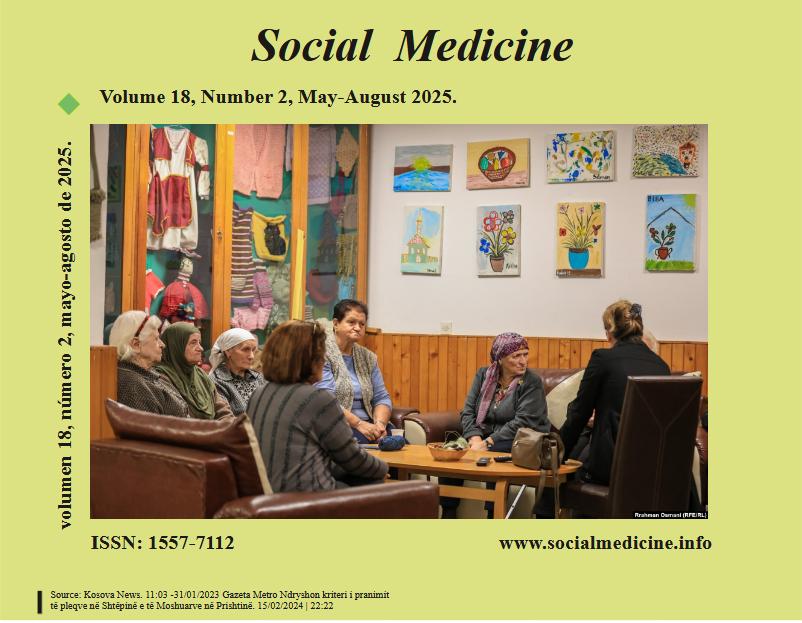
Cuidados de ancianos en transición: experiencias de personas mayores en tres residencias de ancianos de Kosovo
DOI:
https://doi.org/10.71164/socialmedicine.v18i2.2025.1933Palabras clave:
cuidados de ancianos, residencias de ancianos, transición, cuidados de larga duración, KosovoResumen
Objetivo.en Kosovo, en las políticas de saludo, la atención a las y los jóvenes ha llevado a descuidar la de las personas mayores. Sin embargo, a medida que cambia la demografía, se espera que su número aumente en los próximos años. El objetivo de este estudio fue evaluar sus percepciones sobre su vida cotidiana y sus experiencias en residencias de ancianos, centrándose en los aspectos que repercuten en su bienestar. Material y métodos.para la recolección de datos se utilizó un enfoque cualitativo mediante entrevistas individuales, empleando un cuestionario modificado. En total, se incluyeron tres residencias de ancianos de 24 horas: dos en el municipio de Peja y una en el e Gjakova, en Kosovo. Resultados.las y los ancianos evaluaron positivamente la calidad de la atención en las residencias, incluyendo el personal, la comodidad, la comida y la limpieza. Sin embargo, se enfrentaban a sentimientos de soledad, falta de nuevas conexiones sociales y limitaciones en su salud. La mayoría expresó su deseo de permanecer más tiempo en sus propios hogares, la transición a un nuevo entorno de vida fue emocionalmente agotadora, lo que provocó un profundo sentimiento de añoranza de sus familias. Conclusiones.las personas mayores percibieron positivamente los cuidados en las residencias, valorando la atención del personal, el ambiente familiar, el confort, la calidad de la comida y la limpieza. Sin embargo, también se enfrentaron a problemas de salud y emocionales, como la sensación de soledad y la falta de contactos sociales. Es crucial crear servicios de apoyo a domicilio para posponer su traslado a residencias, poner en marcha iniciativas sociales y de salud mental para abordar la soledad y ofrecer servicios sanitarios especializados para gestionar las enfermedades crónicas.
Citas
World Health Organization. Long-term care [Internet]. 2022 [cited 2024 Dec 1]. Available from: https://www.who.int/europe/news-room/questions-and-answers/item/long-term-care
World Health Organization. Ageing and health [Internet]. 2018 [cited 2024 Oct 1]. Available from: https://www.who.int/news-room/fact-sheets/detail/ageing-and-health
Hoti F. Impact of physical activity on longevity: A review of the literature. Atena J Public Health. 2021;3:1–10.
Ukëhaxhaj A, Sutaj B, Terziqi H, Vrella A, Hoxha F. Knowledge, attitudes, and behaviors toward proper nutrition and lifestyles in Kosovar diabetic patients. Int J Biomedicine. 2024;14(1):110–7. doi: https://doi.org/10.21103/Article14(1)_OA17
Greve B. Long-term care for the elderly in Europe: Development and prospects. Roskilde University, Denmark: Department of Society and Business; 2020.
Sullivan LJ, Asselin ME. Revisiting quality of life for elders in long-term care: An integrative review. Nurs Forum. 2013;48(3):191–204. doi: https://doi.org/10.1111/nuf.12030
Leichsenring K, Billings J, Henk N, editors. Improving policy and practice in long-term care. In: Long-term care in Europe: Improving policy and practice. Palgrave Macmillan; 2018. p. 325–36.
Chang YP, Li J, Porock D. The effect on nursing home resident outcomes of creating a household within a traditional structure. J Am Med Dir Assoc. 2013;14(4):293–9. doi: https://doi.org/10.1016/j.jamda.2013.01.013
Poey JL, Hermer L, Cornelison L, Kaup ML, Drake P, Stone RI, et al. Does person-centered care improve residents' satisfaction with nursing home quality? J Am Med Dir Assoc. 2017;18(11):974–9. doi: https://doi.org/10.1016/j.jamda.2017.06.007
Cho E, Kim H, Kim J, Lee K, Meghani SH, Chang SJ. Older adult residents' perceptions of daily lives in nursing homes. J Nurs Scholarsh. 2017;49(5):495–503. doi: https://doi.org/10.1111/jnu.12314
Rijnaard MD, van Hoof J, Janssen BM, Verbeek H, Pocornie W, Eijkelenboom A, et al. The factors influencing the sense of home in nursing homes: A systematic review from the perspective of residents. J Aging Res. 2016;2016:1–17. doi: https://doi.org/10.1155/2016/6143645
Gilbert AS, Garratt SM, Kosowicz L, Ostaszkiewicz J, Dow B. Aged care residents’ perspectives on quality of care in care homes: A systematic review of qualitative evidence. Res Aging. 2021;43(7–8):294–310. doi: https://doi.org/10.1177/0164027521989074
Hebb, D.O. (2002) The organization of behavior: a neuropsychological theory, 1st edn. Psychology Press. doi: https://doi.org/10.4324/9781410612403
Drageset J, Haugan G, Tranvåg O. Crucial aspects promoting meaning and purpose in life: Perceptions of nursing home residents. BMC Geriatr. 2017;17(1):1–9. doi: https://doi.org/10.1186/s12877-017-0650-x
Harouni MD, Tabrizi KN, Fallahi-Khoshknab M, Fadayevatan R, Maddah SS. Older people's perceptions of intergenerational relationships in nursing homes: A qualitative content analysis. J Family Med Prim Care. 2022;11(8):4395–403. doi: https://doi.org/10.4103/jfmpc.jfmpc_273_22
Shpakou A, Klimatckaia L, Furiaeva T, Piatrou S, Zaitseva O. Ageism and loneliness in the subjective perceptions of elderly people from nursing homes and households. Fam Med Prim Care Rev. 2021;23(4):475–80. doi: https://doi.org/10.5114/fmpcr.2021.110366
Van der Elst E, Dierckx de Casterlé B, Gastmans C. Elderly patients' and residents' perceptions of 'the good nurse': A literature review. J Med Ethics. 2012;38(2):93–7. doi: https://doi.org/10.1136/medethics-2011-100046
Bradshaw SA, Playford ED, Riazi A. Living well in care homes: A systematic review of qualitative studies. Age Ageing. 2012;41(4):429–40. doi: https://doi.org/10.1093/ageing/afs069
Kwong EW, Lai CK, Liu F. Quality of life in nursing home settings: Perspectives from elderly residents with frailty. Clin Nurs Stud. 2014;2(1):100–10. doi: https://doi.org/10.5430/cns.v2n1p100
Lee TW, Cho E, Yim ES, Lee HS, Ko YK, Kim BN, et al. Activities of daily living in nursing home and home care settings: A retrospective 1-year cohort study. J Am Med Dir Assoc. 2015;16(2):114–9. doi: https://doi.org/10.1016/j.jamda.2014.07.013
Schenk L, Meyer R, Behr A, Kuhlmey A, Holzhausen M. Quality of life in nursing homes: Results of a qualitative resident survey. Qual Life Res. 2013;22(10):2929–38. doi: https://doi.org/10.1007/s11136‐013‐0400‐2
Evangelista RA, Bueno AA, Castro PA, Nascimento JN, Araújo NT, Aires GP. Perceptions and experiences of elderly residents in a nursing home. Rev Esc Enferm USP. 2014;48(2):81–6. doi: https://doi.org/10.1590/S0080-623420140000800013
Mafluha Y, Indrayani I, Djami M, Pusmaika R, Nurzannah S, Novfrida Y, et al. The quality of life for the elderly: Meeting their needs in a nursing home. J South India Medicolegal Assoc. 2020;12(2):60–9.
Buzgova R, Ivanova K. Violation of ethical principles in institutional care for older people. Nurs Ethics. 2011;18(1):64–78. doi: https://doi.org/10.1177/0969733010385529
Kosovo Agency of Statistics. Kosovo population projection [Internet]. 2018 [cited 2024 Nov 19]. Available from: https://www.ceicdata.com/en/kosovo/population-projection-kosovo-agency-of-statistics
AGE Platform Europe. Study on the long-term care systems in the Western Balkans [Internet]. 2023 [cited 2024 Nov 19]. Available from: https://www.age-platform.eu/study-on-the-long-term-care-systems-in-the-western-balkans/
Demir F. Kosovo Albanian refugees, 1999 [image on the Internet]. Balkan Insight. Available from: https://balkaninsight.com/wp-content/uploads/2018/02/kosovo-albanian-refugees-1999-photo-by-fehim-demir-epa.jpg
Lund R, Nielsen LS, Henriksen PW, Schmidt L, Avlund K, Christensen U. Content validity and reliability of the Copenhagen social relations questionnaire. J Aging Health. 2014;26(1):128–50. doi: https://doi.org/10.1177/0898264313510033
Murphy K, Cooney A, Casey D. Improving the quality of life for older people in long-term care settings. J Comp Eff Res. 2014;3(3):301–15. doi: https://doi.org/10.2217/cer.14.20
Nakrem S, Vinsnes AG, Harkless GE, Paulsen B, Seim A. Ambiguities: Residents’ experience of “nursing home as my home.” Int J Older People Nurs. 2013;8(3):216–25. doi: https://doi.org/10.1111/j.1748‐3743.2012.00320.x
Roberts T, Bowers B. How nursing home residents develop relationships with peers and staff: A grounded theory study. Int J Nurs Stud. 2015;52(1):57–67. doi: https://doi.org/10.1016/j.ijnurstu.2014.07.008
Firm LC. Socialization improves well-being of elderly in long-term care [Internet]. 2019 [cited 2024 Nov 19]. Available from: https://clawfirmpc.com/socialization-improves-well-being-of-elderly-in-long-term-care-setting/
Ymerhalili G, Bytyci A, Maxhera O, Stein V, Dorner T. Integrated care for older people in Kosovo. Int J Integr Care. 2019;19(51):1–8.
Quehenberger V, Cichocki M, Krajic K. Sustainable effects of a low-threshold physical activity intervention on health-related quality of life in residential aged care. J Clin Interv Aging. 2014;9:1853–64. doi: https://doi.org/10.2147/CIA.S70359
Descargas
Publicado
Número
Sección
Licencia

Esta obra está bajo una licencia internacional Creative Commons Atribución-NoComercial-SinDerivadas 4.0.